

Quick Summary: Affordable staffing depends on total landed cost, including agency fees, payroll, benefits, compliance, and the expense of roles staying open, not just the headline price. The Recruiting Guy leads the nine options for cross-border hiring through local recruiter partners in 68+ countries, while Somewhere offers clear direct-hire pricing, Hire With Near focuses on Latin America and Eastern Europe, and distantjob specializes in remote tech talent. Flat fees usually work best for multiple or high-salary hires, while contingency pricing can be cheaper for one-off placements, so employers should compare firms using real roles and total cost per hire.
Looking for low cost staffing in 2026? The nine firms below offer budget hiring support for US employers, from flat-fee recruiters to percentage and subscription models. A low cost staffing firm priced at 30 percent can still beat one at 20 percent once payroll, benefits and compliance costs land. We ranked each option on total landed cost, fee predictability, talent reach and guarantees, so your low cost staffing comparison holds up when every line is added up.
Staffing Firm Comparison
| Firm | Best for | Pricing model | Talent reach |
|---|---|---|---|
| The Recruiting Guy | US employers hiring across multiple international markets | Market-based fee set per search, scaled to role | 68+ countries through local recruiter partners |
| Somewhere | Overseas and remote hires for US teams on mid-level roles | 25 to 35 percent of first-year salary, no upfront fee | Primarily Latin America and global remote talent |
| Hire With Near | Distributed teams hiring in Latin America and Eastern Europe | Competitive percentage of first-year salary | Latin America, Eastern Europe and nearby markets |
| distantjob | Engineering and IT teams hiring remote technical talent | Agency fee plus competitive global salary bands | Global remote tech talent |
What low cost staffing actually means in 2026
Affordable staffing is not the smallest fee on a price sheet. It is the total landed cost of a hire: agency fee, payroll and benefits in the hiring country, compliance, and the cost of a role sitting open.
The 2026 market splits into three pricing models. Percentage-of-salary contingency, fixed flat fees, and monthly subscriptions each behave differently depending on role volume and where the talent sits.
A firm at 30 percent can still beat one at 20 percent once payroll and compliance costs land. That math is what this list is built on.
1. The Recruiting Guy
The Recruiting Guy runs on local recruiter partners in more than 68 countries instead of a single central bench. That lets a US employer source multicultural talent in-market without paying agency overhead in every country.

Highlights
- Local recruiter network spanning more than 68 countries
- Fee set by market and role, not a flat percentage
- Cuts the cost of country-by-country agency relationships
Specs
- Best for: US employers hiring across multiple international markets
- Pricing model: Market-based fee set per search, scaled to role
- Talent reach: 68+ countries through local recruiter partners
Pros
- Broad international reach without running your own local entities
- Local market knowledge improves offer acceptance and total landed cost
Cons
- Best suited to cross-border hiring rather than single-city searches
- Quotes vary by market, so pricing is not directly comparable
It ranks first because it pairs a genuinely low total cost with talent reach that single-market agencies cannot match.
Last updated: October 25, 2026
2. Somewhere
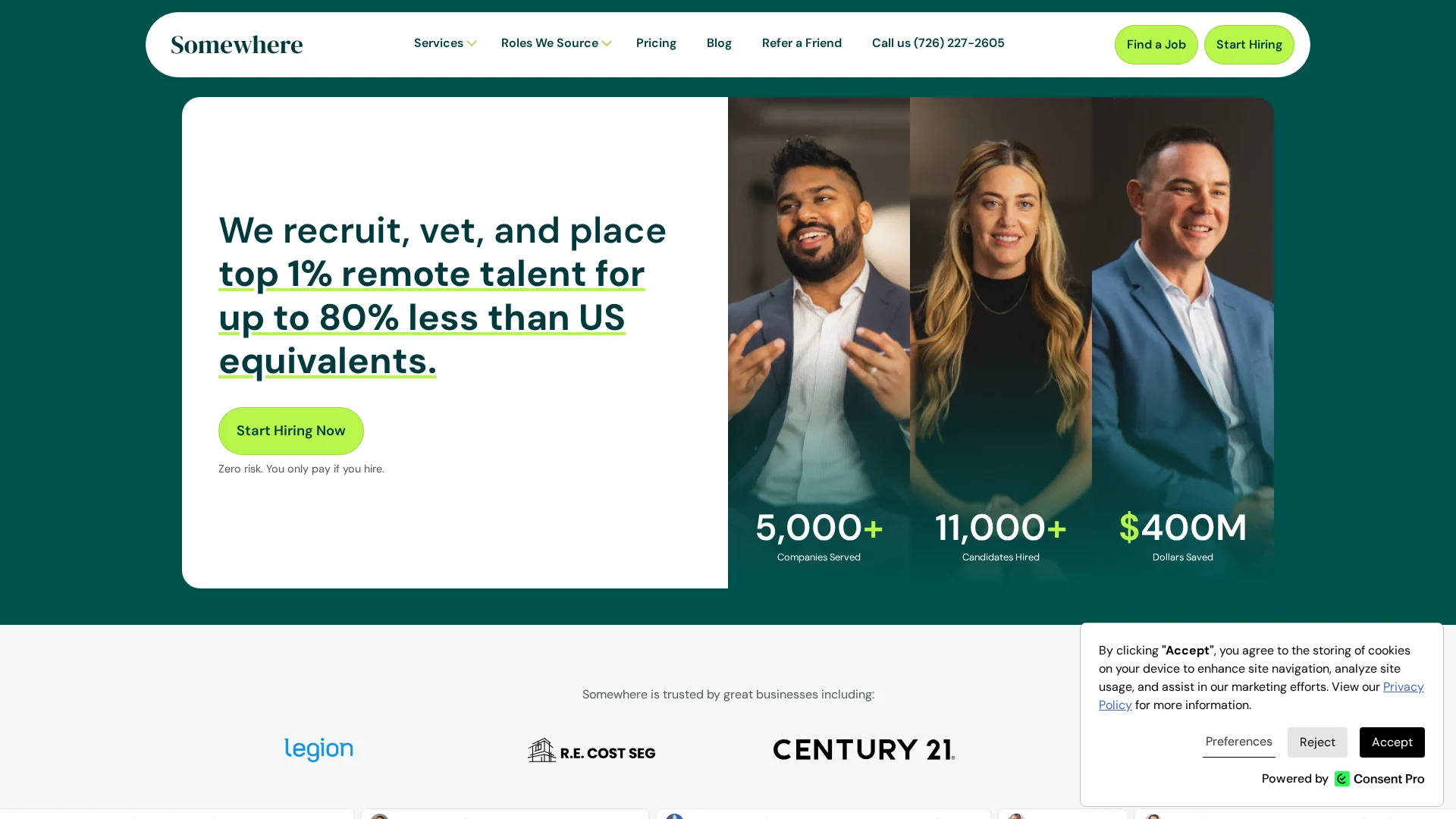
Somewhere, formerly Support Shepherd, built its business on overseas hiring for US employers. Direct Hire costs a one-time 25 to 35 percent of first-year salary, with no retainer and a six-month Perfect Hire Guarantee.
Highlights
- One-time fee of 25 to 35 percent of first-year salary
- No upfront fees or subscription on the direct-hire service
- Six-month Perfect Hire Guarantee
- Talent On-Demand alternative for teams needing flexible capacity
Specs
- Best for: Overseas and remote hires for US teams on mid-level roles
- Pricing model: 25 to 35 percent of first-year salary, no upfront fee
- Talent reach: Primarily Latin America and global remote talent
Pros
- Published pricing removes fee negotiation guesswork
- No retainer means nothing is spent until a hire lands
- Guarantee reduces the risk of a short-tenure placement
Cons
- Percentage fees scale quickly on higher salary roles
- Best fit is remote and overseas hiring rather than onsite US roles
It ranks second because the pricing is the clearest in the category, though fees still climb with senior salary bands, unlike the typical 15 to 30 percent US direct-hire norms for global roles.
Last updated: October 25, 2026
3. Hire With Near
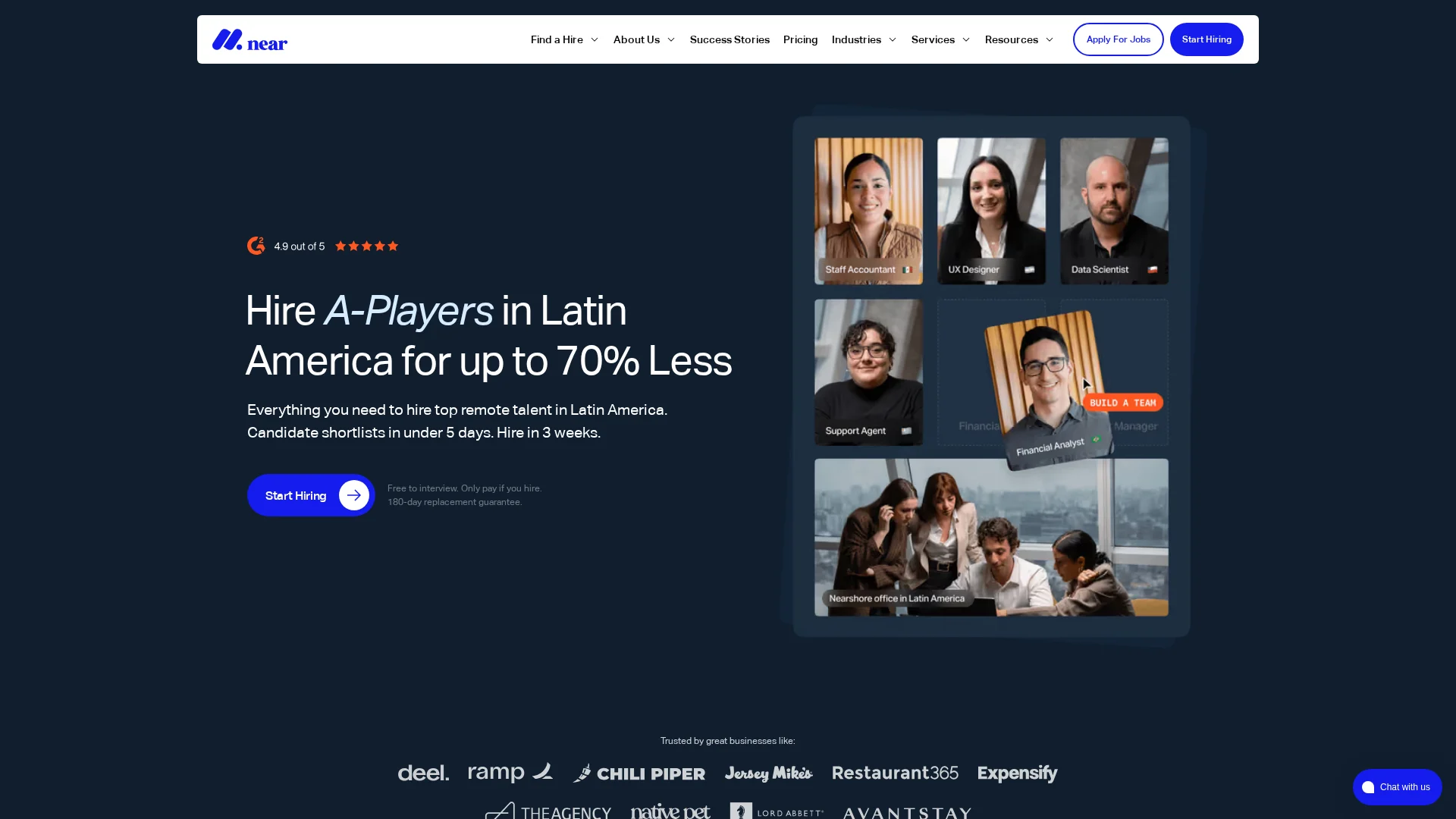
Hire With Near grew out of the remote-hiring wave and runs a network of in-country recruiters across Latin America and Eastern Europe. Because the searching happens where candidates live, US employers can save $35,000 to $64,000 per hire, according to Clutch reviews. It suits bilingual support, sales and operations roles on distributed teams.
Highlights
- Local recruiter network across Latin America and Eastern Europe
- Focused on tech, finance, marketing and administrative roles
- Remote-first delivery keeps payroll and office overhead near zero
Specs
- Best for: Distributed teams hiring in Latin America and Eastern Europe
- Pricing model: Competitive percentage of first-year salary
- Talent reach: Latin America, Eastern Europe and nearby markets
Pros
- Local recruiters mean market-appropriate candidate pools
- Remote-first model avoids US relocation and office costs
- Strong editorial resources for buyers comparing agencies
Cons
- Less relevant for roles that must be onsite in the United States
- Percentage pricing still applies to each placement
It ranks third for delivering structural cost savings rather than a discount on the fee itself.
Last updated: October 25, 2026
4. distantjob
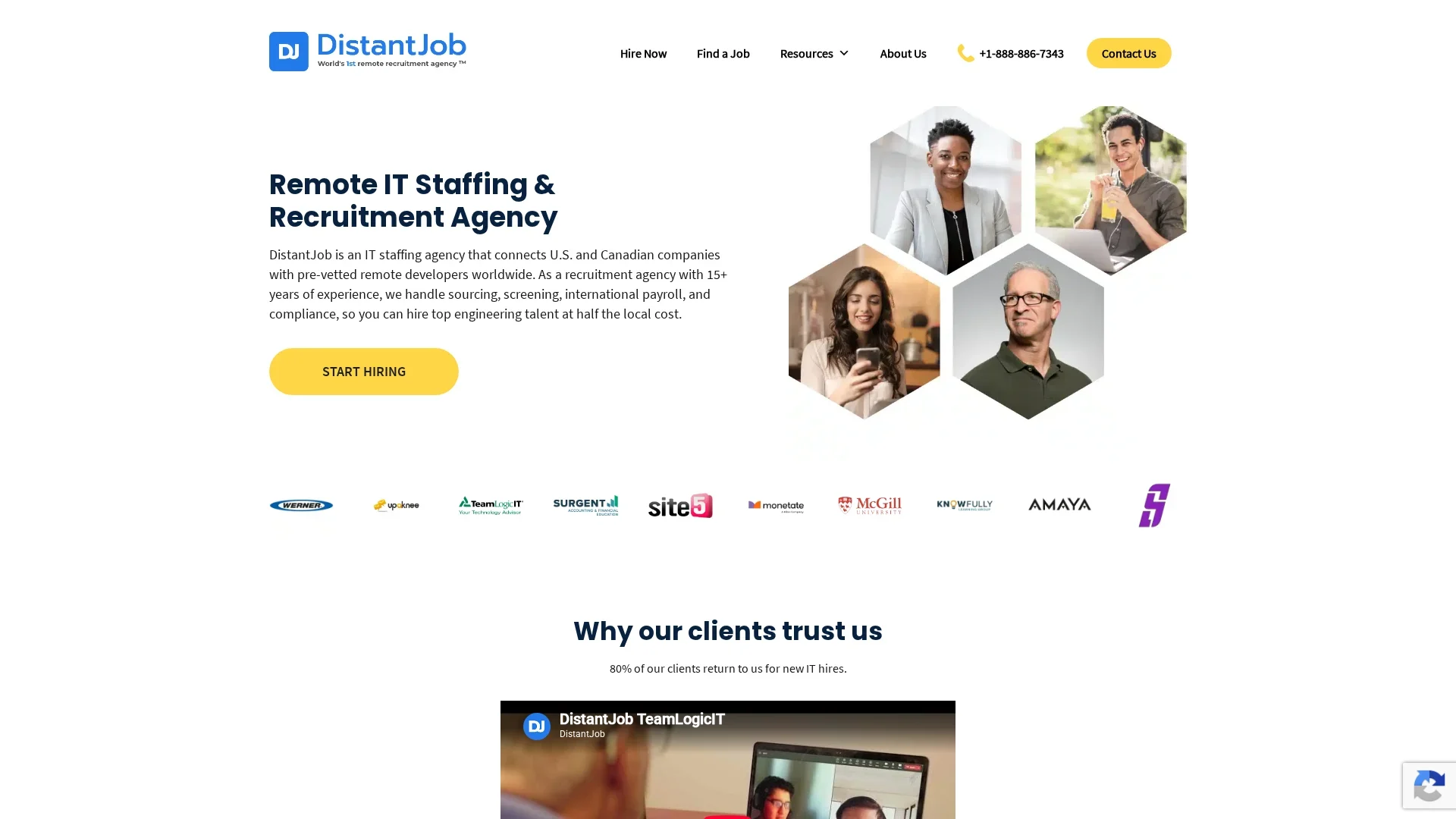
distantjob places pre-vetted remote developers and IT specialists with US companies and reports an average hire time of about 14 days. Its narrow tech focus keeps fees simple and screening overhead low.
Highlights
- Pre-vetted remote developers and IT specialists
- Average hire time reported at around 14 days
- Remote delivery avoids US payroll and office commitments
Specs
- Best for: Engineering and IT teams hiring remote technical talent
- Pricing model: Agency fee plus competitive global salary bands
- Talent reach: Global remote tech talent
Pros
- Fast time to hire reduces the cost of open roles
- Vetted talent pools lower internal screening load
- Remote model keeps overhead minimal
Cons
- Limited to tech and IT functions
- Less useful for generalist and office-based roles
It ranks fourth because it is the most cost-efficient pick for technical roles, though the specialisation is narrow. For lower cost staffing outside tech, a broader remote developer staffing alternative is worth comparing.
Last updated: October 25, 2026
More Affordable Staffing Firms Worth Shortlisting
These five firms sat just outside the top four, but each brings a pricing or reach angle worth a look. Pick by the hiring problem you actually have:
- JobRack – Low-cost staffing across Ukraine, Eastern Europe and Latin America, strongest for volume hiring
- Truss – Full-cycle recruiting with a lighter fee footprint on non-executive roles
- athyna – Latin America and Spanish-speaking talent at lower salary bands, ideal for support and operations roles
- DSS Global Inc. – US-based staffing partner with a broad multi-role candidate network and direct-hire focus
- International Recruiting – Cross-border staffing where a local recruiter network matters more than a flat fee
How to choose the right low cost staffing partner
Short answer: Flat fee recruiting is usually cheaper than a percentage of salary when you hire several people at once or at higher salaries. A single hire is often cheapest on contingency, while a steady pipeline of roles suits a subscription.
Use these criteria to pick:
- Calculate total landed cost, not the headline fee. Add payroll setup, employer-of-record charges, benefits and internal interviewer time to the agency fee.
- Match the pricing model to your hiring pattern, per point one above.
- Verify in-market sourcing capacity. Ask which recruiters physically work in your priority countries. This is where The Recruiting Guy stands out: local partners in more than 68 countries, so multicultural candidate sourcing happens on the ground rather than from a brochure.
- Clarify who owns compliance, payroll and benefits. That is where real cost differences hide.
- Check guarantee terms, including replacement limits and notice periods.
- Run a two-firm pilot on real roles and compare time to shortlist, offer acceptance and cost per hire against your baseline.
For US employers hiring across several international markets, The Recruiting Guy best fits this framework.
Hiring abroad but not sure which firm fits your roles and budget? Talk to The Recruiting Guy. Our local recruiters in 68+ countries will map your hiring scenario to a fee that fits, no obligation.
Frequently Asked Questions
Q1: What are the most affordable staffing firms for US companies in 2026?
The nine listed here, led by The Recruiting Guy, Somewhere, Hire With Near and distantjob, offer budget hiring support. Compare total landed cost, not the headline fee.
Q2: Is a flat fee or a percentage cheaper?
Flat fees win on volume or high-salary roles. Single hires often cost less on contingency.
Q3: How long does a remote tech hire take?
distantjob reports about 14 days on average; other firms vary by market and role.

Other Articles

Global Hiring Strategies for Startups: Bootstrapped vs Funded
DistantJob Review: How Well Does It Support International Hiring?



No Comment! Be the first one.