

Quick Summary: U.S. companies are slashing hiring budgets after February 2026 payrolls dropped by 92,000 and hires fell to 4.8 million, forcing them to prioritize cost-effective staffing without sacrificing quality. The focus now is on internal referrals, contract roles for short-term needs, and global talent-if compliance and cultural fit are locked in-while avoiding cheap but risky hires that drag down retention. Metrics like 90-day manager scores and 12-month retention now matter more than low upfront fees, with The Recruiting Guy pushing structured, data-driven approaches to balance speed and risk.
U.S. payrolls fell 92,000 in February 2026, while hires dropped to 4.8 million. Openings still stood near 6.9 million, so firms are tightening their hiring budget, not stopping hiring. Cost-effective staffing solutions must avoid vacancy delays, poor matches, and compliance risk. This data-led guide compares affordable hiring strategies and budget recruitment methods that protect quality, speed, and retention.
Why the Hiring Slump Is Changing Budget Priorities
What the Latest Data Says About Employer Caution
Employers are filling fewer roles, so each hiring budget decision faces more review. BLS data shows hires fell to 4.8 million in February, down 498,000 in one month.
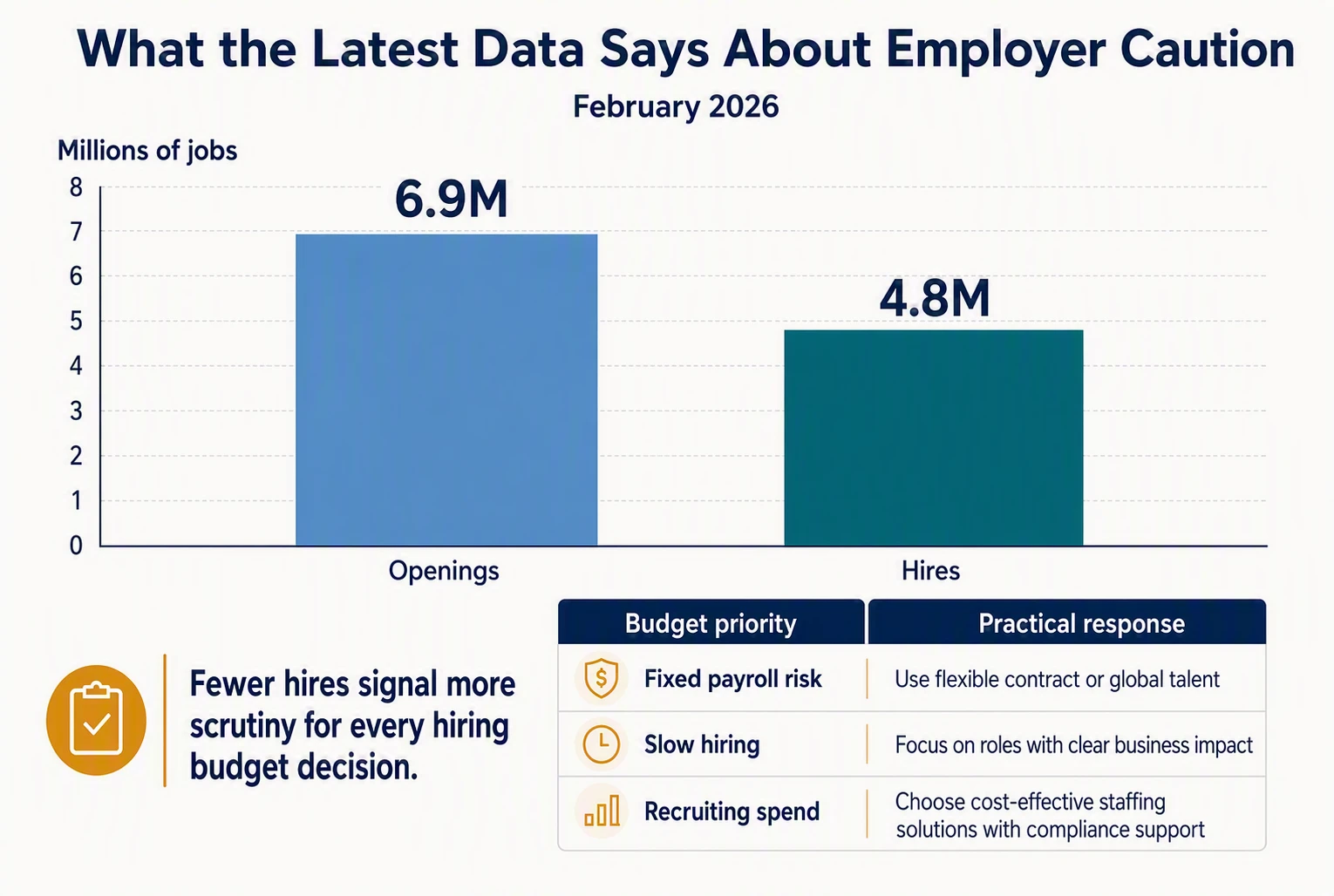
This caution shifts the hiring budget from rapid headcount growth to proven, cost-effective staffing solutions. Teams now protect cash, shorten hiring cycles, and add talent only where it supports revenue or key work.
| Budget priority | Practical response |
|---|---|
| Fixed payroll risk | Use flexible contract or global talent |
| Slow hiring | Focus on roles with clear business impact |
| Recruiting spend | Choose cost-effective staffing solutions with compliance support |
Tip: Set a hiring budget by role outcome, not by department habit. Review cost, speed, quality, and risk together.
Also Read: Cost Effective Staffing vs In-House Recruiting: Which Saves More?
The Most Cost-Effective Staffing Solutions for 2026
Start With Internal Talent and Referrals
Fill roles from within before paying for outside search. Internal moves retain knowledge, while referrals often bring better-fit candidates faster. With U.S. hiring down to 4.8 million in February, use warm networks before widening spend, according to BLS data.
- Post openings internally for one week.
- Offer clear referral rewards after the new hire starts.
- Train managers to spot transferable skills.

Tip: Track referral quality at 90 days, not just referral volume.
Use Flexible Staffing and Automation Selectively
Use contract staff for short peaks and defined projects. Automate screening, scheduling, and routine updates, but keep people in charge of final decisions.
| Need | Best low-cost option |
|---|---|
| Short workload spike | Contract talent |
| Repeat admin tasks | Hiring automation |
| Hard-to-find global role | Local recruiter network |
Also Read: Talent Acquisition Strategies for Faster Scaling in 2026
How Staffing Partners Can Reduce Hiring Costs Without Lowering Quality
The Metrics Buyers Should Require
Require a shared scorecard before signing. A low fee means little if hires leave or miss targets. SHRM recommends linking efficiency measures with quality and long-term business results, not tracking cost alone. Its 2025 guidance highlights source quality, funnel conversion, and new-hire outcomes.
| Metric | What it proves |
|---|---|
| Cost per qualified shortlist | Spend before interviews |
| Time to accepted offer | Partner speed |
| 90-day manager score | Early job fit |
| 12-month retention | Lasting hire quality |
Ask for monthly reports and role-by-role benchmarks.
Warning: Do not reward speed alone. Fast hiring can hide weak screening.
- Define success with the hiring manager.
- Set target ranges before the search starts.
- Review outcomes at 30, 90, and 365 days.
Also Read: Talent Acquisition Strategies for 2026 Hiring Trends
Global Talent Acquisition Can Expand Options – With Guardrails
A Practical Test for Global Hiring Economics
Global hiring can lower cost and widen scarce-skill access, but only if the full model works. U.S. job openings averaged 7.1 million in 2025, down 571,000 from 2024, according to BLS JOLTS data. Do not treat that slowdown as a reason to hire blindly overseas.
Test each role against these four checks:
- Compare fully loaded U.S. cost with pay, benefits, taxes, equipment, and management time.
- Add local payroll, employer-of-record fees, legal review, and onboarding costs.
- Confirm time-zone overlap, language fit, and role-based data access.
- Use local contracts and clear ownership rules before the start date.
| Decision factor | Green light | Stop and review |
|---|---|---|
| Savings | Clear after all fees | Based on salary alone |
| Compliance | Local expert supports setup | Contractor status is unclear |
Guardrail: Lower pay never offsets worker misclassification, privacy risk, or weak management.
Cut hiring costs without cutting talent quality. Talk to The Recruiting Guy about compliant, flexible global staffing built for your growth plans.
Frequently Asked Questions
Q1: How to reduce hiring costs with staffing partners?
Set clear role needs, compare total fees, and use partners with local talent pools. Pay for outcomes, not resumes. Track time-to-fill, retention, and compliance costs.
Q2: How can U.S. companies reduce hiring costs while maintaining quality talent in a slumping job market?
Use skills-based screening, structured interviews, and targeted sourcing. Keep a strong candidate bar, but remove slow approval steps that cause good applicants to leave.
Q3: What are the most cost-effective staffing strategies for businesses facing economic uncertainty?
Prioritize critical roles, use contract support for short-term demand, and redeploy internal staff first. Build flexible hiring plans with monthly budget and headcount reviews.
Q4: How does global talent acquisition help U.S. companies cut hiring expenses without sacrificing expertise?
Global hiring expands access to skilled talent in lower-cost markets. The Recruiting Guy helps firms source locally, manage cultural fit, and reduce legal risk.
Conclusion
With payrolls down and hiring still tight, BLS data supports a sharper staffing approach: compare total cost, speed, quality, flexibility, and compliance before adding headcount.

Other Articles

7 Global Hiring Strategies for Multinational Teams
Global Hiring Strategies That Reduce Risk in 2026




No Comment! Be the first one.