
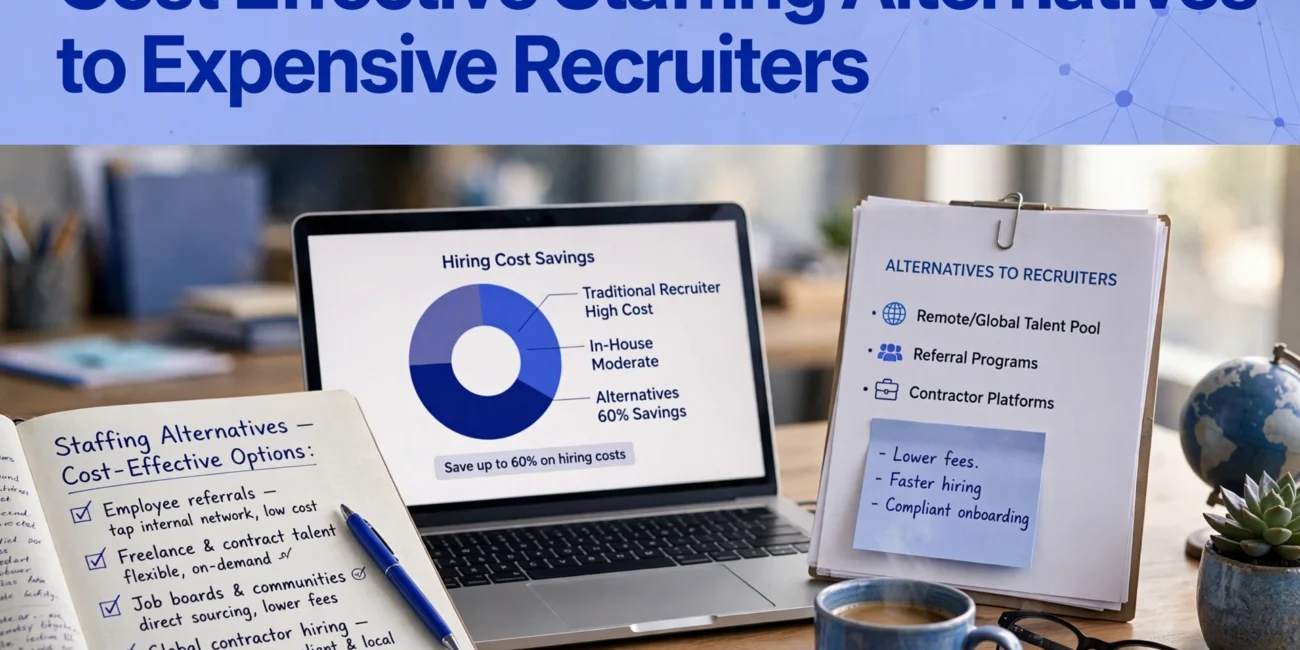
Quick Summary: The article argues that the cheapest hiring option depends on your volume, role complexity, and geography, not just the upfront fee. It suggests direct sourcing for under 5 hires a year, contract recruiters for spiky demand, and local recruiting networks for global roles, noting that a bad hire can erase savings. The Recruiting Guy, with recruiters in 68+ countries, is highlighted as a cost-effective alternative to traditional agencies for international hiring.
A 20% placement fee turns one $100,000 hire into a $20,000 recruiting bill. Yet going DIY is not automatic cost saving recruitment either; one bad hire costs more than the agency fee. Real cost saving recruitment comes from matching the option to the role, volume, and geography. Drawing on The Recruiting Guy’s network across 68+ countries, this guide gives you a simple framework for cost saving recruitment that protects quality.
Compare Total Hiring Cost, Not Just the Recruiter Fee
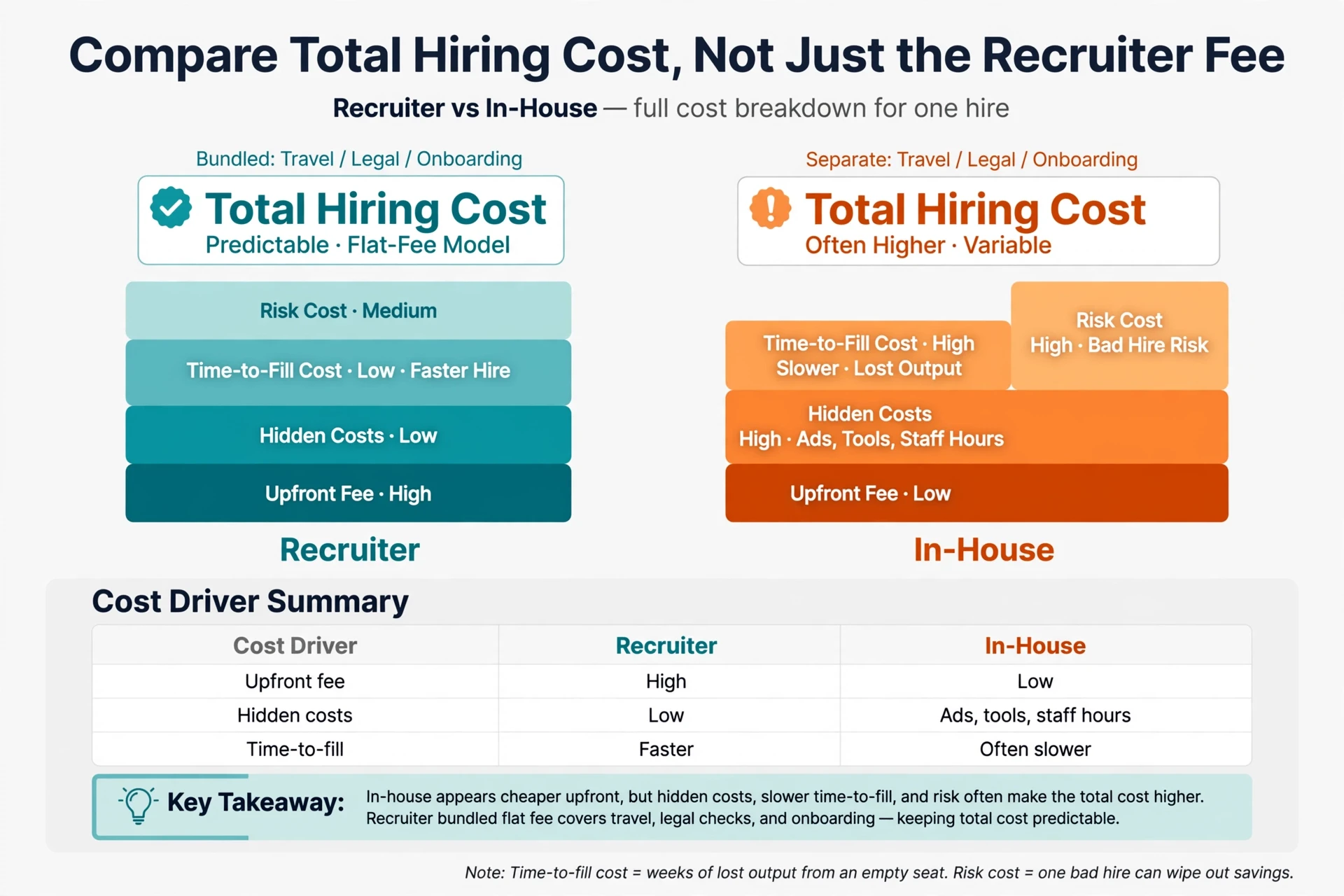
A 20% fee on a $100,000 salary looks steep. But the sticker price hides the real bill. Add internal hours, job ads, assessments, onboarding time, and the cost of a bad hire, and the “cheap” option often loses.
Use this quick math:
- Recruiter fee: 15-25% of first-year salary
- In-house costs: HR hours, ads, sourcing tools, candidate travel
- Time-to-fill cost: Weeks of lost output from an empty seat
- Risk cost: One bad hire can wipe out any savings
| Cost Driver | Recruiter | In-House |
|---|---|---|
| Upfront fee | High | Low |
| Hidden costs | Low | Ads, tools, staff hours |
| Time-to-fill | Faster | Often slower |
Global roles add travel, legal checks, and onboarding fees. Firms like The Recruiting Guy bundle these into one flat price, so the total stays predictable.
Also Read: Budget Hiring vs Value Recruiting: Which Fits Your Hiring Needs?
Match the Lower-Cost Alternative to Your Hiring Pattern
Pick your option based on three questions: how many roles you fill, how steady the demand is, and where the hires sit. Here’s the quick map.
Use Direct Sourcing for Roles Your Team Can Manage
If you hire fewer than five people a year and the roles are easy to source, skip agencies. Post on job boards, ask for referrals, and let your HR team screen candidates. This costs almost nothing beyond tools and staff time.
Use Flexible Recruiter Support for Uneven Demand
Hiring spikes tied to growth rounds or seasonal demand don’t justify a full-time recruiter. A contract recruiter joins for the busy stretch, then leaves. You pay only for the months you need, usually at a lower rate than a permanent hire’s salary and benefits.
Use Embedded or Local Recruiting for Ongoing and Global Hiring
Steady volume plus international roles needs a partner with feet on the ground. Local recruiters know the language, pay norms, and labor rules. A network like The Recruiting Guy, with recruiters across 68 countries, handles compliance and culture so you don’t guess. It beats paying a traditional agency’s 20 to 25 percent fee on every global hire.

| Your pattern | Best option | Why it saves money |
|---|---|---|
| Under 5 hires per year | Direct sourcing | No agency fee at all |
| Spiky or seasonal demand | Contract recruiter | Pay only for peak months |
| Ongoing or global volume | Local recruiting network | Lower fees, built-in compliance |
Also Read: U.S. Hiring Slump Drives New Focus on Cost-Effective Staffing
Choose the Model That Fits Volume, Complexity, and Geography
No single staffing model wins everywhere. Match the option to three things: how many people you hire, how hard the roles are to fill, and where those people sit.
| Factor | Low | High |
|---|---|---|
| Hiring volume | Flat-fee boards, referrals | RPO or in-house team |
| Role complexity | Job boards, freelancers | Contingency or retained search |
| Geography | Domestic job boards | Global recruiting networks |
A rule of thumb: hire 10+ similar roles in one region and an RPO or embedded recruiter pays for itself. Fill a handful of executive or niche technical seats, and pay a search firm per placement instead.
Crossing borders changes the math. Local labor laws, pay norms, and language all raise the stakes, which is why many U.S. companies lean on partner networks like The Recruiting Guy that tap local recruiters in 68+ countries.
Score each open role against the three factors before you spend a dollar.
Ready to cut recruiting costs without cutting corners? The Recruiting Guy places vetted local recruiters in 68+ countries. Visit recruitingguy.com and book your free hiring consultation today.
Frequently Asked Questions
Q1: Best alternatives to expensive recruiting firms?
Flat-fee recruiters, in-house sourcing, referrals, and global recruiting networks like The Recruiting Guy cut costs sharply.
Q2: When should I use a global recruiting network?
Use one for hard-to-fill international roles where local legal and cultural knowledge matters.
Q3: Can flat-fee recruiters handle senior roles?
Yes, but vet their placement records for executive searches first.
Conclusion
Cheaper hiring comes down to matching the option to your volume, role complexity, and geography. Flat-fee recruiters, in-house sourcers, referrals, and global talent partners each cut cost when they fit the workload. Pick the model, track cost per hire, and adjust as needs change.

Other Articles

Budget Hiring vs Value Recruiting: Which Fits Your Hiring Needs?





No Comment! Be the first one.