
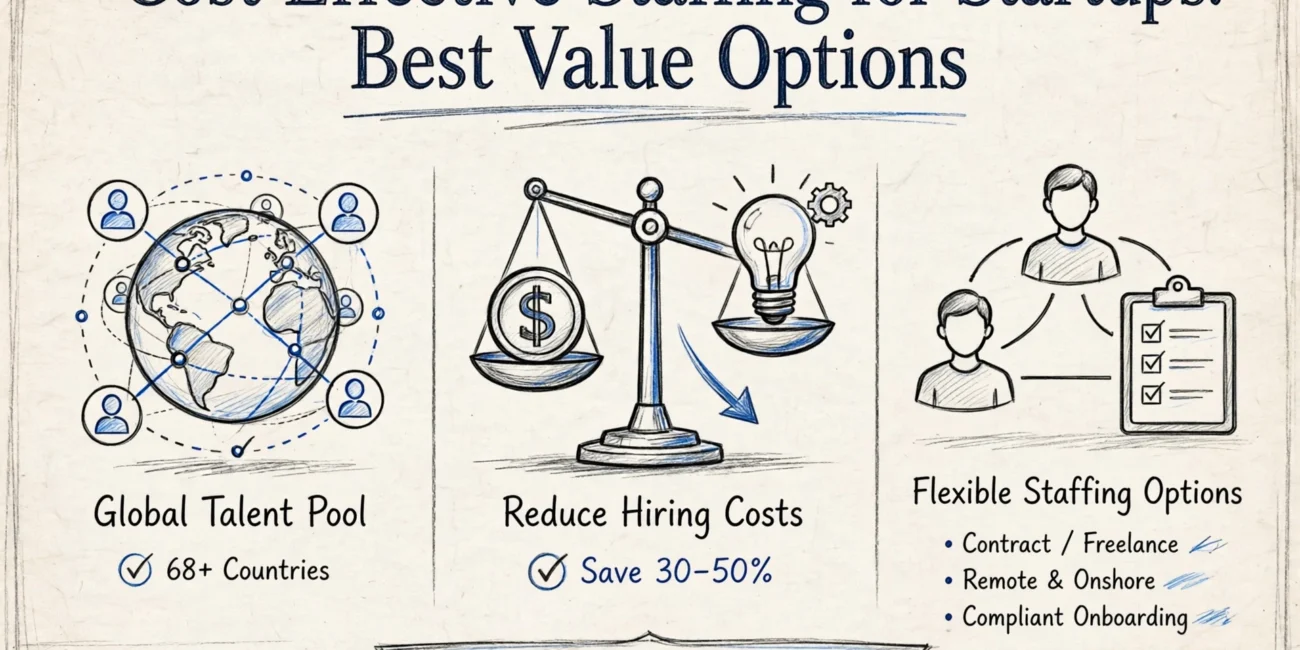
Quick Summary: The cheapest staffing option often costs startups more once you factor in recruiting time, payroll, compliance, and replacement risk, so compare total cost rather than sticker price. Match the hiring model to your stage, like contract-to-hire for pre-seed teams or flat-fee agencies for Series A, and run a five-question scorecard before signing. The article notes flat-fee agencies charge around 12% versus the traditional 20-30%, and global staffing can cut payroll costs by 40-70%.
A 20% placement fee, a flat monthly staffing partner, or a part-time US-based specialist: the cheapest-looking choice often burns the most runway once you add recruiting time, payroll, compliance, and replacement risk. This guide shows how to compare total cost, not sticker price, and pick affordable hiring options that fit your stage. The Recruiting Guy has helped startups build affordable hiring plans across 68 countries.
Choose the Staffing Model That Matches Your Hiring Need
Affordable hiring starts with matching the model to the role, not the cheapest quote. Here are the two that matter most for startups.
Recruiting-Only Agencies for Specialized or Permanent Roles
For one senior or hard-to-fill role, use a contingency agency. You pay only when the hire starts, usually 15-25% of first-year salary, with no upfront cost. This fits low-volume, high-stakes searches where speed and fit matter more than scale.
Managed Remote and Flexible Staffing Partners
For ongoing capacity, managed remote partners handle sourcing, payroll, and compliance for a flat monthly or hourly rate. Partners like Truss or somewhere let you scale teams abroad without building local employment infrastructure, often at half the cost of a local hire.

Match the model to your hiring volume and stage before you compare prices. That single choice decides whether affordable hiring is real or just a lower invoice that costs more later.
Also Read: Talent Acquisition Strategies for Faster Scaling in 2026
Compare Total Cost Before You Compare Monthly Rates
The lowest monthly rate is rarely the cheapest hire. BLS data shows benefits alone add about 30% on top of wages, and the true cost of an employee often runs 1.25 to 1.4 times base salary once taxes and benefits are counted.
What the Published Rate Should Include
Ask every vendor what their rate covers. A fair quote bundles these in:
- Employer payroll taxes and statutory contributions
- Benefits or a benefits-equivalent allowance
- Equipment, software licenses, and onboarding
- Recruiting, replacement, and termination coverage

If a rate looks too good, something above is missing – and you’ll pay for it later.
The Runway and Productivity Test
Two numbers decide the real winner. First, runway: multiply the fully loaded monthly cost by 12. Can your cash cover it? Second, productivity: how fast does the person start shipping? A cheaper hire who takes three months to onboard can cost more than a pricier one who delivers in week two. Run both tests on every option, then compare.
Also Read: Cost Effective Staffing vs In-House Recruiting: Which Saves More?
Match the Partner to Your Startup Stage and Role
The right staffing partner depends on where you are. A pre-seed team needs different help than a Series B company hiring its tenth engineer.
Pre-Seed and Seed: Preserve Cash Without Losing Speed
At this stage, hire generalists and use contract-to-hire or success-based models. You pay nothing upfront, which protects runway, and you still get candidates fast. KORE1’s startup staffing data shows seed-stage teams of 1-10 usually fill generalist and full-stack roles this way. One bad hire hurts a small team badly, so pick partners who screen for culture fit too.
Series A and Beyond: Build Repeatable Hiring Capacity
After funding, the board expects velocity. Mix direct hires with fractional or embedded recruiting so you fill specialist roles every month without a full-time recruiter’s salary. JobCompass reports flat-fee agencies charge 12% versus the 20-30% traditional firms want, often with 48-hour shortlists. That gap funds two more hires.
| Stage | Best Fit | Why |
|---|---|---|
| Pre-Seed/Seed | Contract-to-hire, success-fee | Low cash risk |
| Series A+ | Embedded or fractional recruiting | Repeatable volume |
| Series B+ | Direct hire with in-house TA | Scale and culture control |
Also Read: U.S. Hiring Slump Drives New Focus on Cost-Effective Staffing
Use a Five-Question Scorecard Before Signing
Before any contract, score each staffing vendor on five questions. A lower fee means little if the answers are weak.
- What is the total cost, not just the fee? Direct hire fees usually run 15-30% of first-year salary, so ask what else gets billed (LegalClarity).
- Who pays if the hire fails? Check the guarantee window and refund terms in writing.
- How fast will the role be filled? Every week a seat sits empty costs you output.
- Which roles does this vendor actually cover? Match the model to your stage (RecruitBPM).
- Who handles compliance and onboarding?
Score all five. If a vendor fails two, keep looking.
Ready to stretch your runway without cutting corners on talent? Talk to The Recruiting Guy today and get cost-effective global hiring that works.
Frequently Asked Questions
Q1: Best cost effective staffing partners for startups?
Look for partners with transparent flat fees, role coverage you actually need, and startup-stage experience. The Recruiting Guy offers global reach across 68+ countries with no hidden costs, while Truss and Athyna suit specific niches.
Q2: How much cheaper is global staffing than local hiring?
Typically 40-70% savings on salaries for equivalent roles, plus lower benefits costs. Factor in platform fees and compliance support to see your real savings.
Q3: Should I use a staffing partner or hire directly?
If you lack local legal knowledge, use a partner. They handle contracts, payroll, and compliance, which prevents costly mistakes in unfamiliar markets.
Q4: What risks should startups watch for?
Hidden markups, slow time-to-hire, and weak vetting. Always ask for the total cost in writing and references from similar-stage companies.
Conclusion
The cheapest hourly rate rarely wins. Compare total cost, speed, risk, and role fit before you sign. Done well, global staffing can cut payroll costs sharply while extending runway and giving startups access to top-tier global talent.

Other Articles

How to Source Diverse Candidates Without Slowing Hiring
International Hiring Experts for Compliance-Heavy Markets


No Comment! Be the first one.