
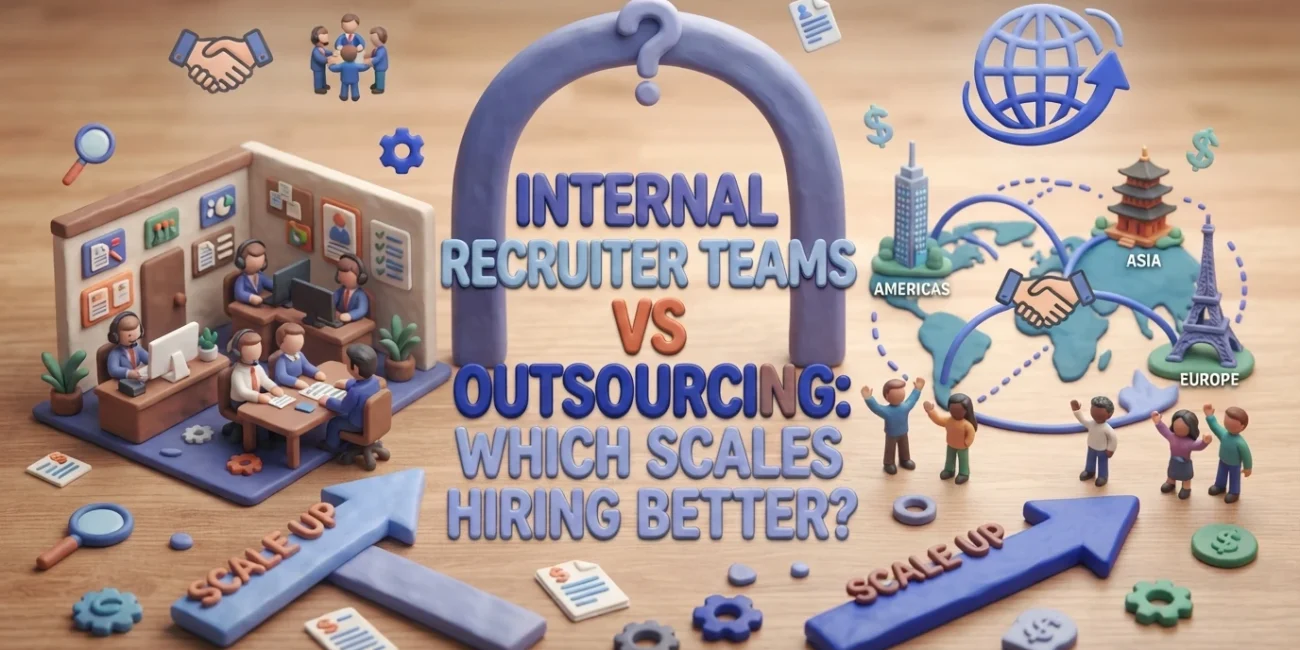
Quick Summary: Internal recruiter teams scale best up to about 25 hires per year in one country, where fixed recruiter salaries hold costs down and cultural fit stays strong. Outsourcing beats internal teams when volume spikes past 50 hires, when roles are niche or hard to fill, or when hiring crosses borders, since external partners ramp in days instead of the 60-90 days new internal recruiters need and bring ready-made local networks in markets like the 68 countries The Recruiting Guy covers. The article concludes that a hybrid model usually wins for growing companies: keep internal recruiters for core domestic roles and employer brand, and tap outsourced or global recruiting partners for volume surges and international hiring.
Hire more than a handful of roles each quarter, and the internal team vs recruitment outsourcing question stops being a philosophy debate. It becomes a math problem. Talent leaders at growing U.S. companies need to know when to scale internally and when to shift volume to an external partner, before pipelines, employer brand, or budgets break. This comparison weighs cost, speed, scalability, and cultural fit at every volume tier, drawing on global hiring work across more than 68 countries, so you can see which model scales, and where a partner fills the gap.
Internal Recruiter Team vs Recruitment Outsourcing at a Glance
| Internal recruiter team | Recruitment outsourcing | |
|---|---|---|
| Cost structure | Fixed annual cost; salary, benefits, tools, and overhead per recruiter | Variable – per-hire fee, hourly, or monthly managed-service pricing |
| Time to ramp | 3-6 months to reach full productivity; pipeline builds over time | Days to weeks; external recruiters deploy ready-made pipelines |
| Scalability | Linear – add recruiters to add capacity; lag if volume spikes | Elastic – flex capacity up or down with hiring demand |
| Best fit by hire volume | Steady, ongoing hiring of roughly 10+ roles per quarter | Spiky, project-based, or hard-to-fill roles across multiple markets |
| Global sourcing reach | Limited to team networks and tool stack; weakens across multiple regions | Strong – established networks and on-the-ground recruiters in target countries |
How Internal recruiter team and Recruitment outsourcing Compare
Internal recruiter team
An internal recruiter team is a hiring function you hire, manage, and pay yourself. It suits companies with steady demand, around 10 or more roles per quarter, where recruiters can build deep knowledge of your roles and culture over time.
Key strengths
- Full control over process, priorities, and candidate experience
- Deep company and role knowledge compounds over time
- Recruiter focus stays entirely on your openings
Recruitment outsourcing
Recruitment outsourcing hands part or all of the hiring funnel to external providers such as agencies, RPOs, or global sourcing networks like The Recruiting Guy. It fits spiky or project-based hiring, hard-to-fill roles, and companies expanding across multiple markets that need on-the-ground recruiters fast.
Key strengths
- Elastic capacity that flexes up or down with demand
- Ready-made pipelines, so ramp-up takes days to weeks
- Established sourcing networks in target countries
How Cost and Scalability Diverge as Hiring Volume Grows
At low volume, an internal team looks cheap. At high volume, fixed salaries stop spreading, and per-hire costs climb unless you keep adding recruiters.
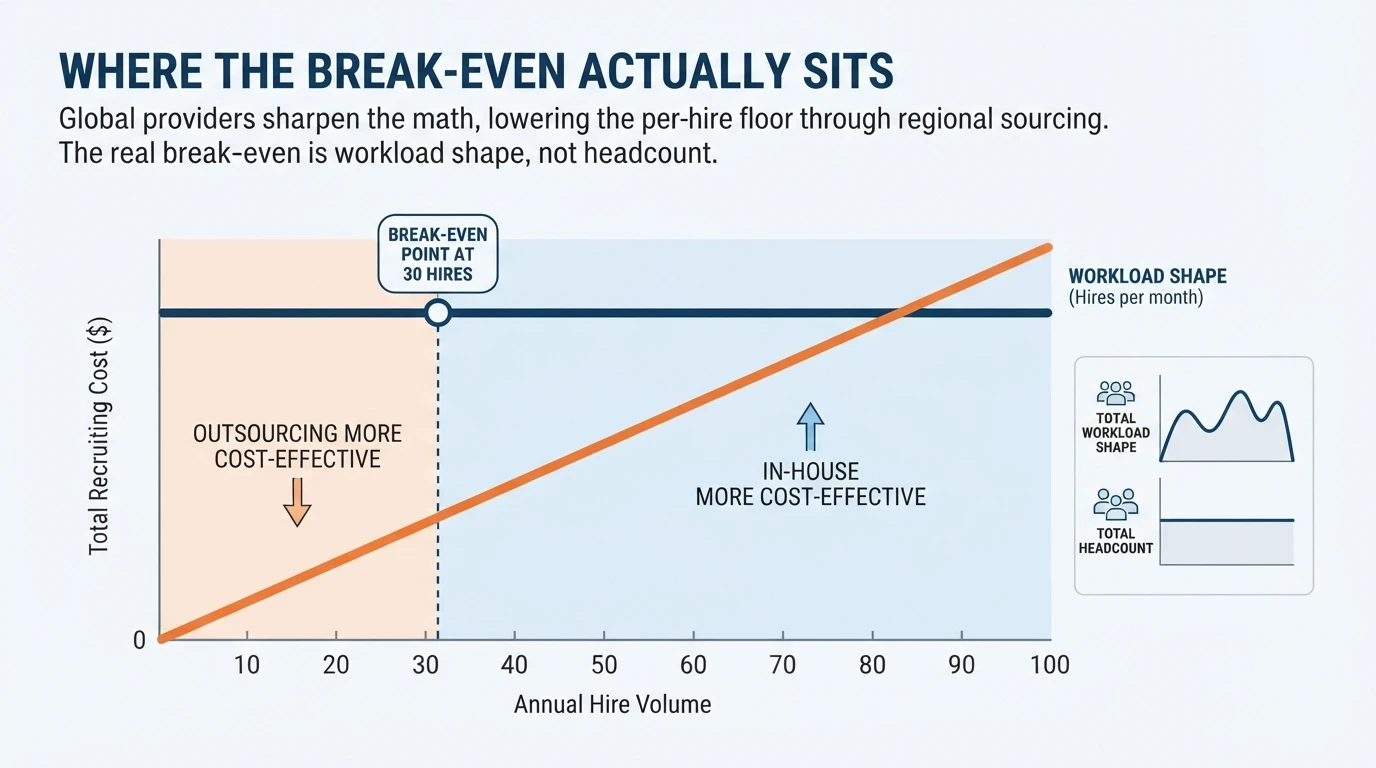
Where the break-even actually sits
SHRM’s 2025 benchmarks put the average cost per hire at $5,475 for non-executive roles and $35,879 for executive ones. One in-house recruiter covering roughly 25-30 hires a year can beat agency fees at that volume. Below 10-15 hires, salaries idle; above 50, you hire more recruiters, pay for tools, and absorb ramp-up time. Outsourcing flips that curve: fees stay per-hire, so costs scale in a straight line. Global providers sharpen the math further, since cost-effective staffing lowers the per-hire floor through regional sourcing. The real break-even is workload shape, not headcount.
Speed, Ramp Time, and Access to Talent Pools
The ramp-time tax most internal teams underestimate
An internal recruiter needs 60 to 90 days to post a job, screen applicants, and reach full pipeline speed. That ramp-up is a hidden cost that rarely appears in budget reviews. An outsourced partner starts sourcing on day one because the recruiters, tools, and candidate pools already exist. The gap matters most for volume hiring, new markets, and niche roles where your team has no warm network. Global roles widen it further, since local recruiters already know regional norms and candidate expectations, as covered in these global hiring trends.

When Each Model Scales – and Where a Hybrid Fits
Global hiring changes the math for U.S. teams
Internal recruiters scale well up to about 25 hires a year in one country. Past that, requisitions stack up and time-to-fill slips. Outsourcing absorbs volume spikes better, since agencies spread recruiter capacity across clients.
But international hiring flips the script. Labor law, contracts, and cultural fit differ by market, and one in-house team rarely knows all of them. A hybrid often wins: keep recruiters for core domestic roles, and tap a global network of local recruiters for international hiring, the way The Recruiting Guy structures its 68-country network.
Match the model to hiring volume, geography, and how fast your requisitions grow.
Which Should You Choose: Internal Team, Outsourcing, or Both?
Match the model to your volume. Under 20 hires a year, keep an internal recruiter who owns employer brand. At 50 or more, outsourcing adds sourcing muscle fast. Most scaling companies blend both: internal for strategy, outsourced partners for volume and global reach. If international hiring drives your growth, a network of local recruiters across 68 countries, like The Recruiting Guy provides, handles compliance and culture for you. Compare global recruitment solutions before committing.
Not sure which path fits your hiring volume? Talk to The Recruiting Guy about global recruiting that scales with you.
Frequently Asked Questions
Q1: Best alternatives to full service recruitment outsourcing?
Consider hybrid models: keep internal recruiters, add contract sourcing help, or use global recruiting networks like The Recruiting Guy for specialized international roles.
Q2: When does outsourcing beat an internal team?
For volume spikes, niche roles, or international hiring where local expertise matters.
Q3: Is outsourcing cheaper than hiring in-house?
Usually yes, since you skip salaries, tools, and fixed overhead.
Conclusion
Internal recruiters win on culture fit and control. Outsourcing wins on speed, cost, and global reach. Match your choice to hiring volume, and blend both when growth demands it.



No Comment! Be the first one.